ZigaForm version 7.6.9

Bubbling and Blistering Finishes in Persistent Humidity: When Vapor Pressure Overcomes the Coating System

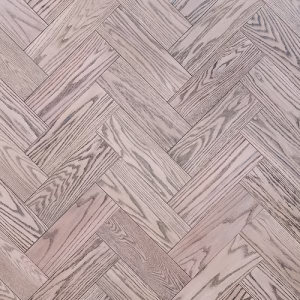
Photo of newly installed light finish herringbone flooring

Why Finish Failures Shift in August

Finish bubbling that appears in August is not the same phenomenon seen in early summer.

Earlier in the season, bubbles often relate to transitional moisture movement—short-term vapor pressure changes as buildings warm up or become occupied. By August, the dynamic changes. Moisture exposure is no longer intermittent. It is persistent, cumulative, and system-wide.

Late-summer blistering reflects a finish system that has been subjected to sustained vapor pressure beneath the coating, long enough for stress to exceed what the film can tolerate. The failure mode shifts from small, isolated bubbles to larger, more aggressive blisters that do not self-resolve.

At Huggins Wood Floor Specialists, August blistering is evaluated as a system saturation issue, not a coating defect. Understanding why these failures change character late in the summer is essential to avoiding ineffective repairs.

Vapor Pressure Beneath Finish Films

Finish films do not exist in isolation. They sit atop a substrate that continues to exchange moisture with its environment.

In persistent humidity:

  • Moisture accumulates within the wood and subfloor

  • Diffusion continues, even when evaporation slows

  • Vapor pressure builds gradually beneath the coating

Unlike liquid moisture, vapor pressure is invisible and relentless. It increases as long as moisture input exceeds moisture release. Over time, the pressure seeks relief at the weakest point in the system—often the finish film itself.

This is why blistering often appears after weeks of apparent stability, not immediately following a moisture event.

Finish Film Permeability and Elastic Limits

All finishes have limits—both in permeability and elasticity.

Permeable finishes allow slow vapor transmission, which can help relieve pressure under normal conditions. Under sustained humidity, however, vapor generation can exceed the film’s transmission capacity.

Elasticity behaves similarly. Finishes can flex to accommodate minor stress, but prolonged pressure causes:

  • Film stretching

  • Loss of cohesive strength

  • Eventual rupture or blister formation

Importantly, the film may remain bonded to the substrate. The failure is not adhesion loss—it is mechanical deformation under sustained stress.

IMG_7472

Why August Failures Are Larger and More Aggressive

Late-summer blistering tends to be more severe for several reasons.

By August:

  • Substrates are closer to moisture saturation

  • Overnight drying cycles are minimal

  • Daytime heat increases vapor generation

The pressure differential between the substrate and the ambient air is reduced, limiting relief. As a result, pressure accumulates longer and releases more forcefully when it finally breaks through.

This is why August blisters are often:

  • Larger in diameter

  • More numerous

  • Faster to propagate

They represent cumulative stress finally exceeding system tolerance.

Visual and Tactile Indicators

August blistering has a distinct presentation.

Common indicators include:

  • Raised, dome-like blisters rather than pinholes

  • Soft or hollow-feeling areas when pressed

  • Finish that appears intact but lifted

  • Localized clusters rather than uniform distribution

Unlike early-season bubbling, these blisters rarely flatten on their own. Their persistence is a sign that pressure conditions remain active.

Trending

Common Misdiagnoses

Late-summer blistering is frequently misdiagnosed, leading to ineffective or damaging responses.

Common incorrect conclusions include:

  • “The finish is defective”

  • “The product wasn’t compatible”

  • “The application was done incorrectly”

While application issues can cause defects, August blistering is rarely explained by workmanship alone. The finish is reacting appropriately to conditions beneath it.

Misdiagnosis shifts focus to the coating, when the real issue lies in moisture management within the system.

This NYC apartment hallway balances architectural rigor with rich materiality—note the custom ceiling inlay, paneled walls, and seamless wood flooring. Art and lighting details add warmth and rhythm to the corridor’s refined geometry.

Evaluation Strategy

Proper evaluation requires looking below the surface.

A sound diagnostic approach includes:

  • Measuring moisture content beneath the finish

  • Comparing affected and unaffected areas

  • Observing changes over time, not just at one moment

  • Correlating blister behavior with environmental conditions

At Huggins Wood Floor Specialists, evaluation prioritizes determining whether vapor pressure is still building, stabilizing, or dissipating. That distinction governs whether any repair attempt has a chance of lasting.

Why Spot Repairs Rarely Work

Spot repairs are appealing because blistering often appears localized. Unfortunately, they rarely succeed in August conditions.

Spot repairs fail because:

  • Moisture remains trapped below the film

  • New coatings reintroduce solvents and seal the surface

  • Vapor pressure cycles continue

The repaired area often blisters again—sometimes larger than before. Each attempt compounds the problem by adding layers without addressing pressure.

Surface correction without pressure relief is temporary at best.

IMG_7462

Specification Strategies

Preventing late-summer blistering begins at the specification level.

Effective strategies include:

  • Designing for long-term vapor management, not just installation conditions

  • Selecting finish systems appropriate for expected humidity exposure

  • Accounting for substrate moisture behavior during peak summer

  • Establishing environmental performance expectations beyond project closeout

Specifications that assume moisture exposure will be brief leave finish systems vulnerable to August conditions.

Why August Blistering Reflects System Saturation, Not Surface Failure

Bubbling and blistering that appear in August are not sudden finish failures. They are the visible result of system saturation and prolonged vapor pressure finally overwhelming the coating.

By the time blisters form, the system has been under stress for weeks or months. Surface repair alone cannot resolve a pressure problem that remains active.

At Huggins Wood Floor Specialists, late-summer blistering is interpreted as a signal that the flooring system has reached its moisture tolerance limit. Our role is to determine whether conditions can be stabilized, whether damage will progress, and whether any corrective work will endure.

August finish failures are not about what was applied.

They are about what the system has been holding—and for how long.

NYC Showroom

Los Angeles Showroom

© 2026 All Rights Reserved.

Discover more from NYC Wood Floors | Herringbone, Chevron & Wide Plank | Refinishing

Subscribe now to keep reading and get access to the full archive.

Continue reading