ZigaForm version 7.6.9

Tannin Discoloration Under Persistent Summer Humidity: When Wood Chemistry Reacts to Long-Term Moisture Exposure

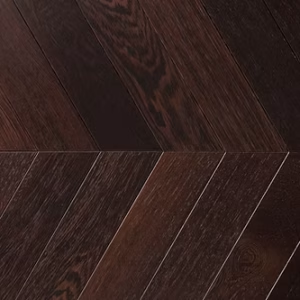
Chevron Wide Plank Hardwood Flooring with Brass and Metallic Inlay by Huggins Wood Floor Specialist

Why August Reveals True Chemical Discoloration

August is when wood floors stop reacting to moisture—and start changing because of it.

Earlier in the year, discoloration often appears as a short-term response to moisture movement: rebound from winter dryness, brief wetting events, or temporary chemical activation. In August, the mechanism is different. Moisture exposure is no longer episodic. It is persistent, sustained, and often unavoidable.

This is when tannin-related discoloration becomes unmistakable.

Unlike spring activation, which may appear and stabilize, true tannin discoloration deepens over time. Color migrates, darkens, and becomes more complex week by week. The longer the exposure persists, the more chemically entrenched the discoloration becomes.

At Huggins Wood Floor Specialists, August tannin discoloration is evaluated as a sign of chronic moisture exposure interacting with wood chemistry, not as a surface defect or finishing error. Recognizing that distinction is critical to determining whether remediation is possible—or whether the damage is progressive.

What Tannins Are and Why They Matter

Tannins are naturally occurring organic compounds found in many wood species, most notably oak, but also in walnut, chestnut, and others.

Under dry or well-managed moisture conditions, tannins remain chemically stable within the wood structure. They are not defects, and they do not migrate. Their presence is inherent to the material and typically invisible once the floor is finished.

Problems arise when moisture exposure becomes prolonged.

Under sustained humidity:

  • Tannins become mobile

  • Chemical reactivity increases

  • Migration pathways open

Once activated, tannins do not simply “turn off” when conditions improve. Their behavior changes with duration, not just intensity.

Persistent Humidity vs Temporary Moisture Events

One of the most common misinterpretations of tannin discoloration is assuming it results from a single moisture event.

Temporary moisture exposure—such as a short leak or seasonal rebound—can activate tannins briefly. Persistent summer humidity is different.

In August:

  • Moisture diffusion continues slowly but steadily

  • Evaporation is limited by already-saturated air

  • Drying cycles are incomplete or absent

The result is trapped moisture within the flooring system. This extended dwell time allows chemical reactions to proceed far beyond what short-term exposure would permit.

Duration, not peak moisture level, is the defining factor.

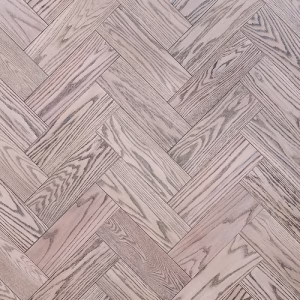
White Oak Wide Plank Herringbone Rift and Quartered with Woca Natural Oil

How Tannin Discoloration Develops

Tannin discoloration develops along moisture pathways, not randomly.

Moisture may enter through:

  • Subfloor assemblies

  • Slabs or crawlspaces

  • Perimeter conditions

  • Humid interior air that never fully dries

As moisture migrates, tannins dissolve and move with it. Interaction with:

  • Metal fasteners or debris

  • Iron-bearing construction dust

  • Certain adhesives or substrates

can intensify discoloration, often darkening it dramatically.

This is why August discoloration frequently appears layered or complex—it reflects both chemistry and movement, not a single reaction.

Visual Characteristics Unique to August Discoloration

True tannin discoloration under persistent humidity has a distinct visual profile.

Common characteristics include:

  • Irregular darkening that does not follow sanding patterns

  • Feathered edges that slowly expand rather than stop abruptly

  • Increasing color depth over weeks, not days

Unlike surface staining, the discoloration often appears embedded within the wood. It may look muted at first, then intensify as moisture exposure continues.

This progression is a key diagnostic indicator.

Trending

What Tannin Discoloration Is Not

Correct diagnosis requires ruling out common assumptions.

August tannin discoloration is:

  • Not surface staining that can be wiped or abraded away

  • Not finish failure, as film integrity is usually intact

  • Not necessarily evidence of an active leak

While moisture is always involved, the presence of discoloration alone does not identify the source. Chronic humidity, not liquid water, is often the driver.

Mislabeling the condition leads directly to inappropriate remediation.

This NYC apartment hallway balances architectural rigor with rich materiality—note the custom ceiling inlay, paneled walls, and seamless wood flooring. Art and lighting details add warmth and rhythm to the corridor’s refined geometry.

Diagnostic Approach

Proper evaluation of tannin discoloration follows a structured process.

First, moisture mapping establishes whether elevated moisture is ongoing and how it varies across the floor and substrate.

Second, species identification confirms whether tannin-rich wood is present and how susceptible it is to chemical migration.

Third, subsurface evaluation determines whether discoloration is superficial or embedded, and whether chemical activity is still ongoing.

At Huggins Wood Floor Specialists, diagnosis focuses on whether the reaction is active, stabilizing, or complete. That distinction determines whether any corrective work has a chance of success.

Why Sanding Often Makes It Worse

Sanding is frequently proposed as an immediate response to discoloration. In August, this approach often accelerates the problem.

Sanding:

  • Exposes fresh, tannin-rich fibers

  • Spreads reactive material across a wider area

  • Increases surface area for continued chemical activity

If moisture conditions persist, discoloration often reappears—sometimes darker and more extensive than before.

Sanding treats the symptom, not the chemistry.

paris-apartment-layers-oak-classic-light-oil-2-5m-300mm-19mm-architect-wood-marsh-16

Specification-Level Prevention

Preventing tannin discoloration requires anticipating long-term moisture behavior, not just installation conditions.

Effective specifications consider:

  • Species selection relative to humidity expectations

  • Realistic assumptions about summer moisture levels

  • Isolation of metal components from tannin-rich woods

  • Environmental control beyond project completion

Ignoring these factors assumes moisture exposure will be temporary. August conditions prove otherwise.

At Huggins, prevention strategies are grounded in how buildings actually perform during prolonged humidity—not how they are intended to.

Why August Tannin Discoloration Signals Chronic Moisture Exposure

Tannin discoloration that emerges or intensifies in August is not a cosmetic anomaly. It is evidence of chronic moisture exposure activating wood chemistry over time.

Once this process is established, surface treatments alone cannot resolve it. The question becomes whether the chemical reaction can be stabilized—or whether damage will continue to deepen.

At Huggins Wood Floor Specialists, August discoloration is evaluated as a long-term system condition, not a finish issue. Our role is to determine what is still reversible, what is not, and whether intervention will meaningfully change the outcome.

August does not reveal sudden problems.

It reveals the consequences of moisture that never truly left—and chemistry that was given time to react.



NYC Showroom

Los Angeles Showroom

© 2026 All Rights Reserved.

Discover more from NYC Wood Floors | Herringbone, Chevron & Wide Plank | Refinishing

Subscribe now to keep reading and get access to the full archive.

Continue reading