ZigaForm version 7.6.9

Soft-Spotting and Footfall Impressions in Summer: Finish Films Under Maximum Service Stress

Why Summer Reveals Finish Performance

Finish systems are typically evaluated under controlled conditions: proper cure windows, stable temperatures, and limited traffic. Summer reveals something very different.

By July, finishes are no longer being tested under curing conditions. They are being tested under full service conditions—heat, humidity, sustained use, and real occupancy patterns. This is when soft-spotting and footfall impressions begin to appear, often in floors that otherwise seem intact and well-finished.

These conditions are commonly misinterpreted as soft finishes, product defects, or improper application. In reality, they reflect how a finish film behaves when pushed to its maximum service stress, often in combination with subtle substrate movement beneath it.

At Huggins Wood Floor Specialists, summer soft-spotting is evaluated as an in-use performance condition, not a finishing failure. Understanding that distinction prevents unnecessary recoating and protects long-term finish durability.

Finish Film Behavior Under Heat

Finish films are temperature-sensitive materials.

As temperatures rise:

  • Finish films become more flexible

  • Resistance to compression decreases

  • Recovery time increases

This does not mean the finish has failed. It means the film is operating closer to its design limits.

In summer conditions, even fully cured finishes may exhibit temporary deformation under load—particularly when heat is combined with humidity. The film can compress slightly, then recover slowly, creating the impression of softness even when chemical cure is complete.

The key issue is not whether the finish cured properly.
It is how it behaves when warm, loaded, and in service.

Substrate Movement Beneath Intact Finishes

Soft-spotting is rarely a finish-only phenomenon.

In summer, wood substrates are:

  • Fully expanded

  • Under lateral compression

  • Less dimensionally forgiving

As expansion pressure fluctuates with daily environmental cycles, subtle vertical movement can occur at the board level—even without visible failure. That movement transfers stress to the finish film above.

The finish does not crack or delaminate.
It deforms to accommodate what is happening below it.

This is why impressions can appear even when the finish is intact and adhesion is sound.

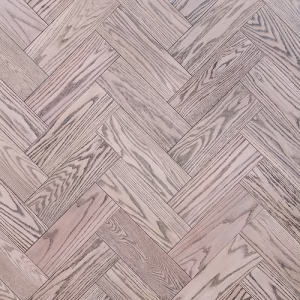
cerused

Load Concentration and Footfall Dynamics

Not all traffic stresses finishes equally.

Soft-spotting often correlates with:

  • Barefoot traffic, where load is concentrated through smaller contact areas

  • Soft footwear that increases dwell time under compression

  • Repetitive paths through kitchens, halls, and transition zones

In summer, these loads are applied to finishes that are warmer, more flexible, and already managing substrate stress. The result is localized deformation that may recover slowly—or incompletely.

This is a use-pattern issue, not a random defect.

Visual and Tactile Indicators

Soft-spotting is identified as much by feel as by sight.

Common indicators include:

  • Matte tracking where sheen temporarily dulls

  • Shallow impressions that are visible at low angles

  • Areas that feel slightly “soft” underfoot

  • Partial recovery after periods of rest

Unlike compression set in wood, these impressions often show some degree of rebound, especially overnight or during cooler periods. That recovery behavior is diagnostically important.

At Huggins, tactile assessment under controlled observation is often more revealing than surface appearance alone.

Trending

Distinguishing Finish Deformation from Wood Compression

Correct diagnosis depends on understanding what recovers and what does not.

  • Finish deformation
    → Often shows partial or full recovery
    → Changes with temperature and use cycles
    → Does not permanently alter wood profile

  • Wood compression
    → Does not recover
    → Persists through environmental change
    → Alters the underlying surface geometry

Confusing the two leads directly to incorrect remedies. Finish deformation may stabilize with time and environmental management. Wood compression will not.

Knowing the difference determines whether intervention is necessary—or harmful.

This NYC apartment hallway balances architectural rigor with rich materiality—note the custom ceiling inlay, paneled walls, and seamless wood flooring. Art and lighting details add warmth and rhythm to the corridor’s refined geometry.

Common Incorrect Remedies

When soft-spotting appears, well-intentioned responses often make conditions worse.

Common missteps include:

  • Recoating before behavior is understood

  • Buffing or abrading during peak summer conditions

  • Attempting to “harden” the finish prematurely

These actions can:

  • Reset cure behavior

  • Reduce film thickness

  • Increase sensitivity to future stress

At Huggins Wood Floor Specialists, premature surface intervention is one of the most common reasons soft-spotting turns into long-term finish instability.

Evaluation Timing and Monitoring

Soft-spotting should be evaluated over time, not at a single moment.

Proper assessment includes:

  • Observing daily temperature and humidity cycles

  • Comparing morning vs evening behavior

  • Logging recovery patterns over several days

  • Correlating impressions with traffic and load

This approach distinguishes temporary service stress from progressive failure and prevents unnecessary corrective work.

Summer conditions demand patience and data, not immediate correction.

IMG_7460

Specification and Finish Selection Guidance

Soft-spotting highlights a gap in many specifications: finishes are selected for appearance and durability, but not always for service behavior under summer conditions.

Effective specifications consider:

  • Expected traffic and load patterns

  • Seasonal temperature ranges

  • Finish flexibility and recovery characteristics

  • Clear occupancy and service timing requirements

At Huggins, finish performance is evaluated not just at cure, but at peak seasonal demand, where real use determines longevity.

Why Summer Use Defines Finish Longevity

Summer is when finishes stop being theoretical and start being tested.

Soft-spotting and footfall impressions are not automatic signs of failure. They are indicators of how a finish system responds under maximum service stress—heat, humidity, load, and use acting together.

At Huggins Wood Floor Specialists, these conditions are interpreted before they are corrected. Our role is to determine whether the finish is behaving within expected limits, whether conditions will stabilize, and whether intervention will improve or shorten the floor’s service life.

July does not ask whether a finish was applied correctly.

It asks whether it was selected, specified, and put into service with real conditions in mind.

NYC Showroom

Los Angeles Showroom

© 2026 All Rights Reserved.

Discover more from NYC Wood Floors | Herringbone, Chevron & Wide Plank | Refinishing

Subscribe now to keep reading and get access to the full archive.

Continue reading