ZigaForm version 7.6.9

Compression Set in Peak Summer Conditions: When Wood Fibers Permanently Collapse Under Load

Why July Is When Compression Set Becomes Permanent

July represents the most demanding operating condition a wood floor will experience all year.

By this point, interior equilibrium moisture content (EMC) is at or near its annual maximum. Expansion pressure is fully developed and no longer transient. Furniture has been in place long enough to apply sustained load. Traffic patterns are established and repetitive. HVAC systems are running continuously, often prioritizing temperature control over moisture balance.

This combination marks a fundamental shift in how wood behaves.

Earlier in the year, wood responds elastically. It moves, compresses, and recovers as conditions fluctuate. In July, that recovery window narrows or disappears entirely. When loads are applied to fully expanded wood for extended periods, fibers are pushed beyond their elastic limit and into permanent deformation.

This condition is known as compression set.

At Huggins Wood Floor Specialists, compression set observed in peak summer is treated as irreversible material damage, not seasonal movement and not surface wear. Understanding why it occurs—and why it does not resolve—requires looking beyond finishes and installation and into fiber mechanics under service load.

Elastic vs Plastic Deformation in Wood

Wood responds to load in two fundamentally different ways.

Under normal conditions, wood exhibits elastic deformation. Fibers compress slightly when loaded and return to their original shape when the load is removed. This is the behavior most people expect when they think of wood movement.

Compression set occurs when deformation becomes plastic rather than elastic.

Plastic deformation means:

  • Fibers are compressed past their ability to recover

  • Structural memory is lost

  • The original shape cannot be restored

This transition does not happen instantly. It occurs when wood is:

  • Fully expanded from moisture uptake

  • Subjected to sustained vertical load

  • Denied sufficient recovery time

July conditions provide exactly this environment. Once fibers yield plastically, no amount of drying will return them to their original form.

Cellular Mechanics of Fiber Collapse

To understand why compression set is permanent, it helps to understand what is actually failing.

Wood fibers are composed of cell walls designed to resist compression up to a point. When load exceeds that capacity for a prolonged period, cell walls buckle and collapse inward. This is not bending—it is crushing.

Once crushed:

  • Cell walls do not re-inflate

  • Internal voids are lost

  • Structural stiffness is reduced permanently

This is why compression set differs from temporary impressions or spring rebound phenomena. The damage is not superficial. It is embedded in the cellular structure of the wood itself.

At this stage, the floor may still look intact, but it has fundamentally changed.

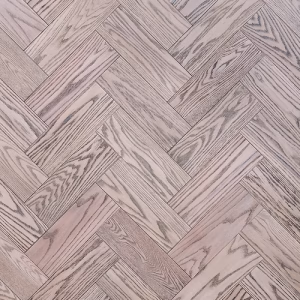
Photo of newly installed light finish herringbone flooring

Environmental Conditions That Enable Compression Set

Compression set requires more than load alone. It requires an environment that prevents recovery.

Key contributing conditions include:

  • Sustained high humidity, keeping wood fully expanded

  • Elevated temperatures, accelerating creep under load

  • Limited overnight moisture relief, especially in continuously conditioned spaces

In peak summer, floors rarely experience the drying cycles that allow fibers to rebound. Instead, they remain swollen while loads remain constant.

This combination converts normal service stress into permanent damage.

Load Sources That Accelerate Damage

Compression set does not occur uniformly. It concentrates where load is greatest and most continuous.

Common accelerators include:

  • Furniture legs and bases applying static pressure

  • Area rugs that trap moisture and restrict surface drying

  • Repetitive traffic paths that stress the same fibers repeatedly

July magnifies these forces because wood is already at maximum expansion. Fibers are pre-stressed laterally before vertical load is applied. What might be tolerable in spring becomes destructive in summer.

This is why compression set often appears suddenly in July, even in floors that seemed stable earlier in the season.

Trending

Field Indicators of Compression Set

Compression set does not announce itself with cracks or dramatic failure. It reveals itself subtly, often mistaken for cosmetic issues.

Common indicators include:

  • Flattened or smeared grain texture

  • Localized low-sheen burnishing

  • Permanent impressions without finish cracking or delamination

  • Areas that remain depressed even as conditions change

A key diagnostic feature is lack of recovery. When impressions persist through environmental shifts, compression set should be suspected.

At Huggins, tactile assessment—feeling the surface under raking light—is often more revealing than visual inspection alone.

This NYC apartment hallway balances architectural rigor with rich materiality—note the custom ceiling inlay, paneled walls, and seamless wood flooring. Art and lighting details add warmth and rhythm to the corridor’s refined geometry.

Common Misdiagnoses and Costly Responses

Compression set is frequently misdiagnosed as:

  • Normal wear

  • Soft or under-cured finish

  • Poor sanding technique

  • Subfloor irregularity

These assumptions lead to corrective actions that often make the damage worse.

Sanding is the most common and most damaging response. Sanding removes already-collapsed fibers, reduces structural depth, and lowers the threshold for future deformation. The floor may look improved temporarily, but the underlying weakness remains—and accelerates.

By the time sanding “reveals” compression set, the damage is already permanent.

Proper Evaluation and Documentation

Correct evaluation focuses on timing, behavior, and response, not appearance alone.

Professional assessment should include:

  • Seasonal timing of onset

  • Load history in affected areas

  • Comparison between loaded and unloaded zones

  • Observation through environmental change

Inspectors should document compression set as permanent fiber deformation under sustained summer load, not as finish or wear-related damage. Language matters. Misclassification leads directly to ineffective remediation.

This is where experienced evaluation makes the difference between managing damage and compounding it.

Herringbone Wood Floors NYC

Specification Strategies to Reduce Risk

Most flooring specifications focus on installation conditions and seasonal movement. Compression set demands consideration of service conditions.

Risk reduction strategies include:

  • Designing for realistic furniture loads

  • Requiring protective measures under static loads

  • Limiting prolonged rug coverage in early service life

  • Selecting species and cuts with appropriate compressive strength

Ignoring peak summer service conditions assumes a recovery window that may not exist.

At Huggins Wood Floor Specialists, compression-set risk is addressed upstream—before fibers are ever asked to endure irreversible stress.

Why Compression Set Defines Long-Term Floor Appearance

Compression set marks a defining moment in the life of a wood floor.

It is the point at which fibers stop recovering and begin failing permanently under normal use. Once it occurs, the floor’s appearance—and its future performance—are fundamentally altered.

This is not a finish problem. It is not a seasonal anomaly. It is material behavior under peak service conditions.

At Huggins Wood Floor Specialists, compression set is evaluated with the understanding that not all damage can be undone—and that knowing when not to intervene is as important as knowing how.

July is when wood floors reveal how they will age.

Understanding compression set—and involving someone who can identify it correctly—is what separates temporary cosmetic fixes from decisions that protect the floor for the remainder of its life.

NYC Showroom

Los Angeles Showroom

© 2026 All Rights Reserved.

Discover more from NYC Wood Floors | Herringbone, Chevron & Wide Plank | Refinishing

Subscribe now to keep reading and get access to the full archive.

Continue reading