ZigaForm version 7.6.9

Dishout and Compression Waves: How Summer Moisture Cycling Deforms Wood Floors

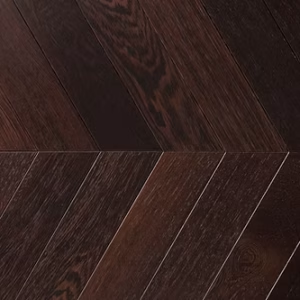
Living space beautifully tied together with chevron floors

Not all wood floor failures announce themselves dramatically.

By late June, some floors remain fully intact—no buckling, no edge lift, no obvious distress—yet no longer look or feel right. Subtle depressions appear along traffic paths. Long, shallow waves develop across rooms. Reflections distort. The surface seems tired, uneven, or worn despite relatively limited age or use.

These conditions are often dismissed as cosmetic wear or attributed to sanding quality. In reality, they are signs of systemic deformation caused by repeated moisture cycling under load.

At Huggins Wood Floor Specialists, dishout and compression waves are evaluated as long-term performance failures, not surface defects. They represent the cumulative effect of summer expansion and contraction acting on wood fibers that are repeatedly stressed past their elastic limit.

This article explains how these deformations develop, why they follow traffic patterns, and why refinishing without addressing underlying conditions almost always guarantees recurrence.

Why June Is the Onset of Cumulative Deformation

June marks a shift in how wood floors are stressed.

Earlier in the year, movement tends to be directional and event-driven: winter shrinkage, spring rebound, early summer expansion. By June, however, moisture change becomes cyclical rather than transitional.

Typical conditions include:

  • Daily humidity swings

  • HVAC cycling on and off

  • Warm daytime temperatures and cooler nights

  • Floors under continuous use

This creates repeated expansion and contraction under load, which is fundamentally different from seasonal movement at rest.

Dishout and compression waves begin when cycles repeat often enough to alter fiber structure permanently.

Why This Is Not Winter Compression-Set or Spring Impressions

It is important to separate this condition from earlier phenomena.

  • Winter compression-set occurs when fibers are crushed during shrinkage and fail to recover.

  • Spring surface impressions occur when temporarily softened fibers deform but may rebound.

Dishout and compression waves are neither.

This is active, cumulative plastic deformation occurring over time, not a one-time injury. Each moisture cycle contributes incrementally, until the surface no longer returns to flat even under stable conditions.

The damage is not revealed later.
It is created gradually, in real time.

Spello

Elastic vs Plastic Deformation: The Core Mechanism

Wood fibers respond to stress in two ways.

  • Elastic deformation: fibers bend and recover when stress is removed.

  • Plastic deformation: fibers yield and permanently change shape.

In summer moisture cycling, floors are repeatedly stressed while bearing traffic loads. Once fibers are pushed beyond their elastic range often enough, plastic deformation accumulates.

The floor does not fail catastrophically.
It slowly loses its original geometry.

This is why the condition is often overlooked until it becomes visually obvious—and difficult to reverse.

Why Dishout Follows Traffic Paths

Dishout rarely develops uniformly.

It tracks where:

  • Foot traffic is concentrated

  • Furniture paths repeat

  • Loads are applied consistently

These areas experience the highest combination of:

  • Moisture-driven dimensional change

  • Vertical compressive load

  • Repetition

As boards expand and contract under load, fibers along these paths compress incrementally. Over time, shallow depressions form that mirror use patterns.

This is not wear in the traditional sense.
It is structural deformation driven by use under cycling conditions.

Trending

Compression Waves: When Deformation Becomes Directional

Compression waves often accompany dishout in larger spaces.

They appear as:

  • Long, shallow undulations

  • Reflection distortion under light

  • Loss of plane without sharp failure

These waves form when expansion pressure is redistributed unevenly across the floor during repeated cycles. Minor restraint differences, subfloor variability, and load patterns interact to create directional deformation.

Because the floor remains bonded and intact, these conditions are frequently misdiagnosed—or ignored until refinishing is proposed.

This NYC apartment hallway balances architectural rigor with rich materiality—note the custom ceiling inlay, paneled walls, and seamless wood flooring. Art and lighting details add warmth and rhythm to the corridor’s refined geometry.

Why Refinishing Without Stabilization Repeats the Failure

Refinishing addresses surface appearance, not fiber condition.

When dishout or compression waves are sanded:

  • Deformed fibers are removed rather than stabilized

  • Structural depth is reduced

  • The system becomes more sensitive to future cycling

If moisture cycling and load conditions remain unchanged, deformation resumes—often faster and more pronounced.

At Huggins, repeated refinishing cycles are a red flag that the real problem has never been evaluated as a system.

Why This Is Often Blamed on Sanding or Craftsmanship

Dishout is commonly attributed to:

  • Aggressive sanding

  • Poor finishing technique

  • Inadequate equipment

These explanations feel intuitive because the symptom is visible at the surface. In many cases, however, the sanding merely reveals deformation that already existed.

Without understanding moisture cycling and load history, corrective work is often misdirected—and responsibility assigned incorrectly.

This is where expert evaluation matters.

IMG_7526

Specification Implications: Designing for Long-Term Cycling

Most specifications address seasonal extremes, not repeated cycling under use.

Long-term performance requires attention to:

  • Interior environmental stability

  • HVAC commissioning and operation

  • Load distribution and use patterns

  • Floor system resilience over time

Ignoring these factors leaves even well-installed floors vulnerable to gradual deformation that no finish system can prevent.

When Floors Degrade Quietly, Expertise Matters

Dishout and compression waves are not dramatic failures. They are quiet ones.

They develop slowly, under normal use, in floors that were never designed—or evaluated—for long-term moisture cycling under load. By the time they are obvious, simple fixes are no longer available.

At Huggins Wood Floor Specialists, these conditions are assessed as system degradation, not surface flaws. Our role is to determine whether a floor can be stabilized, how future deformation can be limited, and whether corrective work will actually last.

June is when acute failures get attention.
It is also when subtle, long-term damage begins.

Knowing the difference—and knowing when to involve someone who does—is what protects floors not just this season, but for the years that follow.

NYC Showroom

Los Angeles Showroom

© 2026 All Rights Reserved.

Discover more from NYC Wood Floors | Herringbone, Chevron & Wide Plank | Refinishing

Subscribe now to keep reading and get access to the full archive.

Continue reading