ZigaForm version 7.6.9

Finish Fisheyes and Cratering in Summer: When Surface Contamination Meets High Humidity

Finish fisheyes and cratering are among the most disruptive defects encountered in wood flooring—not because they are structurally severe, but because they undermine confidence quickly and resist intuitive correction.

In early summer, these defects often appear during finishing or recoating operations that otherwise follow familiar procedures. The finish draws back into circular voids. Craters open where the coating refuses to wet the surface. Attempts to correct the issue during application typically worsen it, spreading defects rather than resolving them.

These failures are routinely attributed to finish formulation, batch inconsistency, or application error. In practice, most summer fisheye and cratering events are surface-energy failures intensified by elevated humidity, not product defects.

At Huggins Wood Floor Specialists, fisheyes observed in June are evaluated as the interaction between trace surface contamination and environmental conditions that eliminate tolerance. The finish is behaving correctly. The surface it is being asked to wet is not.

Why June Is the Fisheye Window

Fisheyes do not suddenly begin in summer—they become unavoidable.

By June, ambient humidity is no longer episodic. It is persistent. Moisture films linger on surfaces longer, solvent evaporation slows, and contaminants that were previously inert become mobile. The margin for error that existed in spring disappears.

Earlier in the year, a surface can tolerate small amounts of contamination without visible consequence. In June, that tolerance collapses. The same preparation methods that appeared successful weeks earlier now fail dramatically, leading teams to assume something “changed” in the finish.

What changed was not the product.
It was the environment’s ability to conceal surface-energy incompatibility.

What Fisheyes and Craters Actually Are

Fisheyes and craters are not adhesion failures and not curing failures. They are wetting failures.

At the moment of application, the finish encounters localized areas of lower surface energy and pulls away from them. The coating remains chemically viable, but it cannot spread uniformly. The result is circular voids with raised edges—classic fisheyes.

This distinction matters because:

  • Adhesion failures occur after application

  • Bubbling and pinholing result from pressure beneath the film

  • Fisheyes occur during flow-out, not later

Treating fisheyes as adhesion problems leads to the wrong corrective strategy and almost guarantees recurrence.

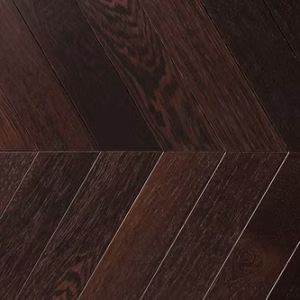
Close-up view of wide plank herringbone wood flooring, showcasing the intricate grain patterns and rich natural tones, ideal for contemporary and classic interior designs.

Sources of Contamination: Why Trace Amounts Are Enough

Most fisheye contamination is not obvious and not intentional.

Common sources include silicone residues from cleaners, oils transferred from hands or rags, lubricants from tools or HVAC equipment, and airborne contaminants from adjacent trades. In many cases, the contamination was introduced days or weeks earlier and remained dormant.

In summer conditions, these materials migrate more readily across the surface. Moisture keeps them active rather than allowing them to dry in place. This is why teams often deny introducing contaminants—and why they may be correct.

The issue is rarely a single mistake.
It is cumulative exposure combined with humidity that removes forgiveness.

Why High Humidity Magnifies Surface-Energy Failure

High humidity affects fisheyes in multiple, compounding ways.

First, slower solvent evaporation gives contaminants more time to repel the finish. Second, moisture maintains contaminant mobility, preventing isolation. Third, finish surface tension becomes more sensitive as environmental moisture increases.

The finish’s ability to bridge over low-energy areas diminishes. What would have flowed out in drier conditions now collapses into voids.

Summer does not introduce contamination.
It eliminates the finish’s ability to tolerate it.

Trending

Why Fisheyes Appear Sudden and Unpredictable

Surface-energy failures are threshold failures.

A surface may appear acceptable through multiple coats until a tipping point is reached. That point may be triggered by slightly higher humidity, a minor delay in application, or a marginal increase in contamination concentration.

This is why fisheyes often:

  • Appear mid-application without warning

  • Affect one room and not the next

  • Occur after several successful coats

The system did not degrade gradually. It crossed a boundary. Once crossed, incremental correction is ineffective.

This NYC apartment hallway balances architectural rigor with rich materiality—note the custom ceiling inlay, paneled walls, and seamless wood flooring. Art and lighting details add warmth and rhythm to the corridor’s refined geometry.

Why Spot Repairs Almost Always Fail

Spot repairs fail because surface-energy conditions are rarely localized.

Sanding does not reliably remove contaminants; it often redistributes them microscopically. Solvents introduced during reapplication can mobilize residues further, expanding the affected area.

Each repair attempt increases variability in surface energy, making subsequent coats less predictable. What began as a small defect becomes a systemic problem.

At Huggins, repeated fisheye repairs are a diagnostic indicator that the issue has been misclassified as surface damage rather than surface incompatibility.

Why These Defects Are Commonly Blamed on Finish Products

Because the defect is visible in the finish, the finish is blamed.

Manufacturers are often asked to explain cratering that has nothing to do with formulation. Changing products rarely resolves the issue because the underlying surface conditions remain unchanged.

This misattribution delays correct diagnosis and leads to escalating rework. The finish is not failing to perform; it is refusing to wet an incompatible surface—as it should.

Kent Oak LVP
Sanding and refinishing of wood floors in Lincoln Square, New York

Preventing Fisheyes at the Specification Level

Fisheye prevention is primarily procedural, not chemical.

Effective specifications address:

  • Prohibition of silicone-based products in the building

  • Control of cleaning agents prior to finishing

  • Isolation of finishing operations from other trades

  • Environmental parameters during summer application

  • Surface preparation standards beyond grit sequence

These measures reduce contamination exposure rather than attempting to overpower it with additives or technique.

Fisheyes Are a Surface Message

Fisheyes and cratering are not finish failures. They are messages about surface conditions delivered at the moment tolerance disappears.

In summer, humidity removes the buffer that once concealed trace contamination. The finish does not misbehave—it responds accurately to a surface it cannot wet.

At Huggins Wood Floor Specialists, fisheyes are evaluated as surface-energy events, not coating defects. That distinction prevents repeated rework, misplaced blame, and unnecessary product changes.

June does not forgive contamination.
Understanding why is what keeps finishing predictable when conditions are not.

NYC Showroom

Los Angeles Showroom

© 2026 All Rights Reserved.

Discover more from NYC Wood Floors | Herringbone, Chevron & Wide Plank | Refinishing

Subscribe now to keep reading and get access to the full archive.

Continue reading