ZigaForm version 7.6.9

White Lines in Wood Floor Finishes

Understanding Finish Fracture Under Winter Stress

By February, many winter wood flooring concerns have moved beyond movement and noise and into appearance.

Fine white lines appear along board edges. Hairline fractures show up at end joints. Under raking light, the floor suddenly looks stressed—sometimes dramatically so. The immediate reaction is almost universal: something must be wrong with the finish.

In mid-winter, that conclusion is often incorrect.

At Huggins Wood Floor Specialists, white lines in wood floor finishes are one of the most frequently misdiagnosed conditions we evaluate during February. They are routinely attributed to finish chemistry, application error, or coating failure. In reality, they are far more often a stress indicator—a visible signal that the wood beneath the finish has exceeded what the finish film can elastically tolerate.

This article explains why white lines appear after weeks of dry winter conditions, why they are rarely caused by defective finishes, and why mid-winter attempts to “fix” them often make the condition worse rather than better.

Why White Lines Appear in February

Finish Fracture Is a Delayed Response

White lines almost never appear at installation or immediately after finishing. They emerge after sustained winter dryness, once wood movement has accumulated and stress has nowhere else to go.

By February:

  • Interior relative humidity is typically at its lowest

  • Wood flooring has already undergone most of its seasonal contraction

  • Tensile stress has been building at restrained points for weeks

The finish does not suddenly fail. It reaches the limit of what it can stretch, bend, or bridge while remaining visually intact.

Winter reveals this threshold.

Why White Lines Are Commonly Misattributed

Finish Chemistry Is the First Suspect

When white lines appear, they are often blamed on:

  • Brittle finishes

  • Improper curing

  • Incompatible coatings

  • Low-quality products

While true finish defects do exist, winter white lines are rarely caused by chemistry alone.

Most modern wood floor finishes—waterborne or solvent-based—are capable of tolerating normal seasonal movement when the underlying system behaves predictably.

White lines typically indicate that the finish is being asked to accommodate more movement than it was ever designed to absorb.

Finish Elasticity vs Wood Movement

Finishes Are Flexible—Within Limits

All wood floor finishes have an elastic range. Within that range, the film can stretch and recover as the wood beneath it moves.

In winter, wood contraction concentrates stress at predictable locations:

  • Board edges

  • End joints

  • Transition zones

  • Areas of restraint

When cumulative shrinkage exceeds the elastic capacity of the finish, the film fractures microscopically.

This is not a bond failure.
It is a tensile failure within the finish film itself.

Why White Lines Follow Board Edges and End Joints

Stress Concentration Points

White lines almost always trace:

  • Along board edges

  • Across end joints

  • At panel interfaces

These locations experience the highest differential movement during winter shrinkage.

As boards contract, edges pull away from one another. If movement is uniform, the finish stretches invisibly. If movement is restrained or uneven, stress localizes at the weakest points.

The finish fractures exactly where the wood demands it.

This is why white lines are a map of stress, not a random defect pattern.

Trending

Why Finish Fractures Appear White

Light Refraction, Not Material Failure

The white appearance of these lines is not due to pigment failure or contamination. It is an optical effect.

When a finish film develops micro-cracks:

  • Light refracts differently through the fractured surface

  • The cracks scatter light rather than transmitting it uniformly

  • The result is a white or chalky appearance along the fracture line

The finish may still be bonded to the wood. It may still protect the surface. But optically, the fracture becomes visible—especially under raking light or low-sheen finishes.

This is why white lines often appear more pronounced at certain times of day or in specific rooms

.


Why Winter Refinishing Almost Always Makes It Worse

Adding Film Does Not Remove Stress

When white lines appear, refinishing is often proposed as a solution. In winter, this approach is usually counterproductive.

Recoating during mid-winter:

  • Adds additional film over an already stressed substrate

  • Traps existing stress beneath new layers

  • Reduces the system’s ability to recover when conditions normalize

If the underlying wood continues to shrink—or has already reached its minimum dimension—the new finish layer is subjected to the same tensile forces.

The result is often:

  • Reappearance of white lines

  • More pronounced fracture patterns

  • Greater difficulty correcting the issue later

At Huggins, we frequently evaluate floors where winter refinishing transformed a reversible condition into a permanent one.

When White Lines Are Reversible—and When They Aren’t

Reversible Conditions

White lines may diminish or disappear when:

  • Interior humidity returns to normal seasonal levels

  • Wood movement stabilizes

  • Stress at edges and joints is reduced

In these cases, the finish film relaxes as the wood re-expands. The fracture becomes less optically visible, even if microscopic evidence remains.

This is why February is often the worst time to judge final appearance.

Irreversible Conditions

White lines are more likely to be permanent when:

  • Movement exceeded the finish’s elastic limit significantly

  • Stress was concentrated by restraint or sidebonding

  • Multiple winter recoats were applied

  • The flooring experienced compression-set

Determining which condition exists requires experience with both finish behavior and winter wood movement—not assumptions based on appearance alone.

Who This Matters To

This issue affects far more than finish contractors.

  • Specifiers need to understand how finish selection interacts with winter movement

  • Finish manufacturers are often blamed for failures rooted in system stress

  • Inspectors must distinguish finish fracture from adhesion failure

  • High-end residential clients need clarity before questioning quality or demanding rework

White lines are not a cosmetic footnote. They are an indicator of how well—or poorly—the flooring system was allowed to move.

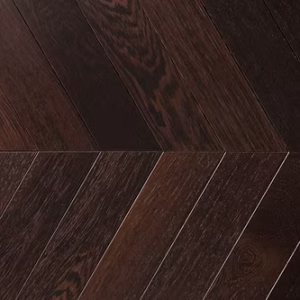
Blaise Chevron Install
Midnight Oak LVP by COREtec, Showcased in a Contemporary Home Design

When Professional Evaluation Is Warranted

White lines should be professionally evaluated when:

  • They appear progressively through winter

  • They concentrate at specific locations

  • Recoating is being considered as a remedy

  • Responsibility or product quality is being questioned

At Huggins Wood Floor Specialists, finish fracture is evaluated in context—considering movement history, environmental conditions, restraint, and timing.

That context determines whether the correct response is patience, documentation, or intervention.

Why We Exist

White lines in wood floor finishes are rarely about the finish alone.

They are the visible result of winter stress exceeding the elastic limits of a coating system. When misunderstood, they lead to premature refinishing, unnecessary disputes, and irreversible outcomes.

February is the point in the season when these lines are most visible—and most misleading.

At Huggins Wood Floor Specialists, white lines are treated not as defects to be covered, but as information to be interpreted. That interpretation often prevents well-intentioned actions from causing lasting damage.

In winter, the most important question is not how do we fix this now?
It is what is the floor still responding to?

Answering that correctly makes all the difference.

NYC Showroom

Los Angeles Showroom

© 2026 All Rights Reserved.

Discover more from NYC Wood Floors | Herringbone, Chevron & Wide Plank | Refinishing

Subscribe now to keep reading and get access to the full archive.

Continue reading